hubbuy Hat Line Brand Research Guide
hubbuy Hat Line Brand Research Guide
hubbuy Hat Line Brand Research Guide
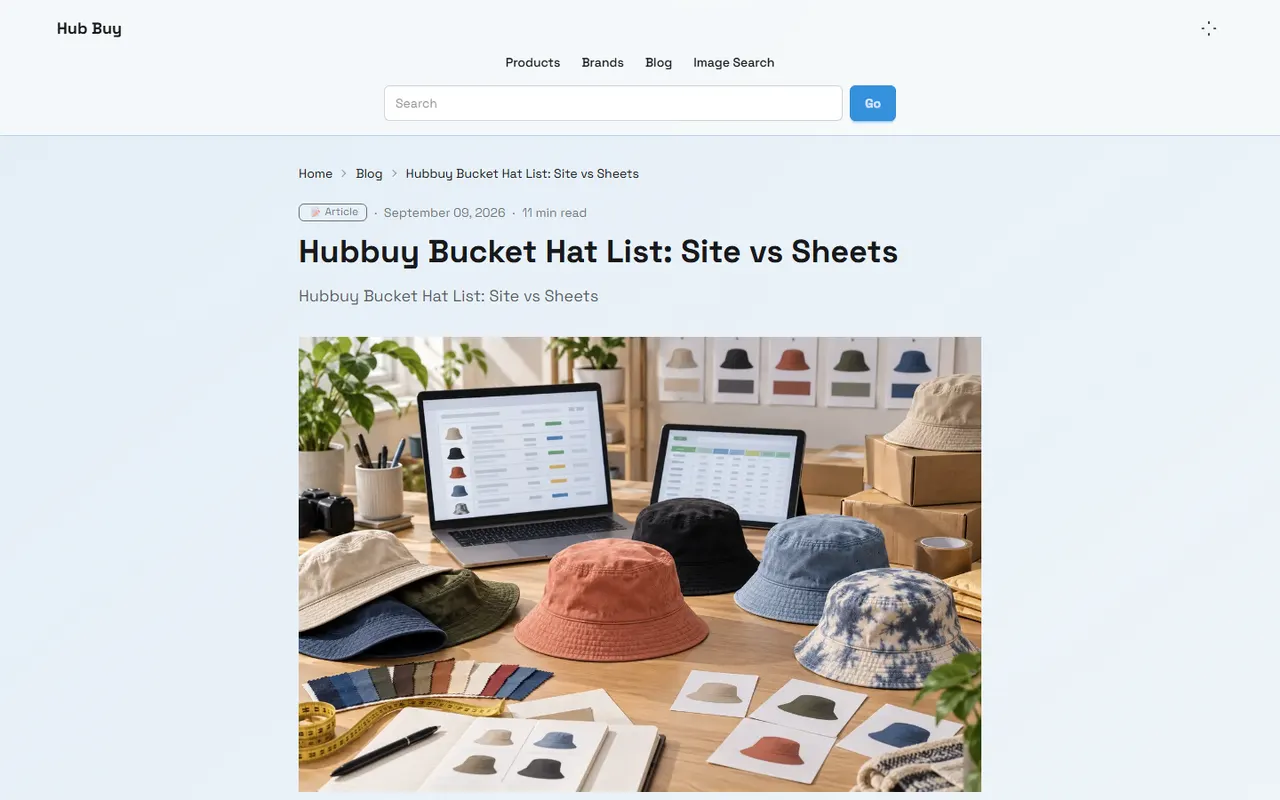
Figure: Hat brand research and purchase review process illustration
Clarify the Hat Research Task at Hand
When searching for hats, bucket hats, baseball caps, or other headwear on hub-buy.net, the real question is not "Is there a name on the page that looks like a brand?" but rather what that name actually represents: a brand owner, a series name, a store name, a descriptive term in the product title, or a category label organized by the platform.
After completing this review, you should be able to:
Determine which content on the product page can serve as evidence of brand attribution.
Distinguish between specifications explicitly stated on the page and your own appearance-based inferences.
Mark sections lacking manufacturer, brand history, or authorization information.
Create a traceable purchase decision record for headwear before ordering.
This guide is intended for buyers who want to understand product origin, brand clues, and actual specifications. It is not suitable for scenarios requiring confirmation of authenticity, official authorization, exclusive distribution, or complete supply chain proof, as a single product page typically cannot independently support such conclusions. 🧭
The platform identity of hub-buy.net and the verifiable purchase process should be recorded separately. The platform displaying product information does not mean the platform is the brand owner, manufacturer, or authorized dealer. When purchasing, you still need to review the current product information, available options, shipping conditions, and after-sales instructions shown on the page.
Distinguish Brand Information, Product Specifications, and Personal Inferences
Hat product pages often place brand, style, material, and marketing descriptions in the same title or image. When organizing information, it is recommended to put each piece into three levels.
Level One is brand information. For example, brand fields explicitly shown on the page, brand labels, packaging markings, or manufacturer names. This content only indicates that the page provides relevant clues; unless supported by independent sources, it cannot be directly recorded as official brand relationship or proof of authenticity.
Level Two is product specifications. For example, hat style, color, size, fabric, brim shape, adjustment method, lining, and dimensions listed on the page. This information can be used for pre-purchase comparison, but should still be based on the visible description on the current product page, with the review date recorded.
Level Three is personal inference. For example, "more suitable for summer," "looks like street style," "might fit larger head circumferences," or "should be relatively stiff." Such content cannot be presented as page facts. Only when the page provides sufficient material, size, structure, or image evidence can you cautiously explain the basis for the inference.
A practical principle is: content that can be found verbatim on the page is recorded as page fact; content that requires derivation from multiple fields is recorded as analysis; content that cannot be supported by the page remains blank. 🔎
Compile Attributable Hat Clues from hubbuy Product Pages
After opening a specific hat product page, first save the page title, product link, brand field displayed on the page, and the review date. Do not just save the short title from the search results page, as search results may truncate names or mix in category words or store information.
Then review in the following order:
Does the product title clearly contain a brand name, or only hat style, pattern, or style words?
Does the page have separate fields for brand, manufacturer, store, or series?
Do the product images show hat logos, hang tags, packaging, or care label information?
Does the specification section list material, head circumference, brim, adjustment structure, and color options?
Does the page provide explanations that support brand attribution, such as official name, manufacturer information, or a verifiable brand page?
During the purchase process, can you confirm specific variants, stock status, shipping options, and after-sales conditions?
If the page only shows a suspected brand word without a brand field, manufacturer information, or logo images, record it as "name clue appears on page" rather than "brand verification completed." If the product images have logos but the text specifications do not have corresponding explanations, list it as a pending verification item.
Page content is time-sensitive. Prices, inventory, variants, shipping, after-sales policies, and link status should be rechecked before publishing or purchasing, and the review date noted. This article does not replace the current page's real-time information and does not provide price or inventory conclusions not confirmed by the page.
Understand Product Positioning by Comparing Hat Style, Material, and Adjustment Structure
Brand verification cannot be separated from the product itself. Even if brand clues are complete, hat style and structure will still affect purchase decisions.
Baseball caps usually require comparison of crown height, brim shape, back adjustment method, and head circumference range. Bucket hats should focus on brim width, crown depth, whether there is a drawstring or fixed structure, and whether the page lists applicable head circumference. Knit or brimless hats need attention to elasticity, thickness, and the page's stated applicable range.
Material information should also be treated in levels. Fiber composition or fabric names explicitly listed on the page can be recorded as specifications; words like "breathable," "soft," or "wearable in all seasons" are product descriptions and cannot automatically be equated to laboratory conclusions. If the page does not provide composition percentage, weight, lining, or care instructions, do not supplement this data for the product.
Adjustment structure is especially important for purchase risk. Adjustable hats usually require confirmation of the position of the adjustment strap, buckle, or drawstring; fixed-size hats should prioritize checking the head circumference given on the page. If the page only provides sizes like S, M, L without a size range, buyers cannot judge fit based solely on hat style images.
You can use the comparison table below to organize candidate products, but the content in the table must come from the corresponding product page or be clearly marked as pending verification.
Verification Item | Record when page confirms | Handling when insufficient |
|---|---|---|
Brand or name | Record page fields and product title verbatim | Mark as name clue, not brand proof |
Hat style | Baseball cap, bucket hat, knit hat, etc. as explicitly classified on page | Do not guess based on personal aesthetics |
Material | Fiber composition or fabric names listed on page | Leave blank if missing |
Size | Head circumference, size range, or adjustment instructions | Mark as pending confirmation if only letter sizes |
Logo and packaging | Only record visible content in images or text | Do not treat image similarity as authorization proof |
Purchase conditions | Current variant, stock, shipping, and after-sales page information | Re-verify before purchase |
Identify Sections Lacking Brand History or Manufacturer Information
When the product page does not provide brand founding date, design team, manufacturer, place of origin, authorization relationship, or official website, it should be clearly written as "not provided on page" rather than replacing it with a similar name from a search engine.
The following situations require extra caution:
The product title contains a brand word, but the page has no independent brand profile.
Images have logos, but there is insufficient clear text or packaging information.
The same name appears on multiple unrelated hats or different seller pages.
The page only describes style, trend, or collaboration concepts without specifying the involved parties.
The product name is similar to a well-known brand, but the page has no official source or authorization information.
These signals alone cannot prove that the product is problematic, nor can they prove that the product is genuine or fake. They only indicate the need for more evidence. A safer approach is to store "visible page facts," "external pending verification facts," and "unconfirmed items" separately.
If you need authenticity judgment, look for official brand channels, authorized sales lists, packaging and product code rules, and consumer protection and return/exchange information applicable to the destination. Do not ask buyers to publicly disclose order numbers, passports, payment cards, or complete shipping labels in exchange for so-called verification proof. 🔐
Create a Hat Brand Profile and Candidate Product Verification Table
It is recommended to create a row for each candidate product and keep original page screenshots or archives. If screenshots contain personal information, cover addresses, phone numbers, order numbers, and payment information first, but do not obscure logos, specifications, or logistics status that affect product judgment.
Records should include at least:
Product title and current product page URL.
Name, brand field, store field, and category displayed on the page.
Hat style, material, color, size, and adjustment structure.
Logos, labels, or packaging content visible in page images.
Price, inventory, variants, shipping, and after-sales information with review date.
Items that can be confirmed, items that require additional evidence, and items that cannot be confirmed.
Final decision: continue verification, compare as unbranded product, or postpone purchase.
Same name does not mean same origin, and similar appearance does not mean same brand relationship. When comparing, prioritize evidence completeness rather than sorting by familiarity or image style. If two products have similar specifications, the page with clearer material, size, variant, and after-sales information usually helps reduce pre-purchase uncertainty, but this still does not constitute a quality guarantee. 📋
Which Purchase Decisions Cannot Rely Solely on Page Information
Page descriptions can help you build a candidate list, but cannot independently answer all purchase questions.
You cannot confirm head circumference fit based solely on title or main image. Look for actual dimensions, adjustment range, or ask the seller for measurement methods, and compare your own head circumference measurement with page data.
You cannot judge comfort, durability, water resistance, or breathability based solely on material name. If these characteristics affect the purchase, look for more specific composition, structure, testing, or after-sales evidence.
You cannot confirm authenticity, collaboration authorization, or manufacturer identity based solely on brand name. Without official sources, it can at most be kept as an incomplete brand clue.
You cannot determine final landed cost based solely on the product page. You also need to review product price, platform or service fees, warehousing and consolidation fees, international shipping, destination taxes, import restrictions, and possible customs documentation requirements. Do not reduce costs through underreporting, splitting orders to avoid taxes, or evading inspections.
If choosing consolidation, first compare duplicate first weight, handling fees, volumetric weight, parcel value, and single loss risk based on actual samples. Consolidation may reduce repeated fixed fees but may increase single package value and route restrictions; splitting may increase fixed fees but may reduce single loss or resolve shipping restrictions. Without sample data, you should not conclude that "consolidation is always cheaper." ✈️
Next Steps: Complete a Traceable Hat Purchase Review
After recording page information, first divide candidate products into three categories: relatively complete evidence, can continue asking, currently cannot confirm. For the second category, ask the seller specific questions, such as head circumference measurement method, material proportion, logo details, packaging contents, available variants, and after-sales window. Questions should focus on purchase decisions, not replace verification with wording like "guaranteed authentic" that cannot be proven by the page alone.
Then recheck the current purchase process on hub-buy.net to confirm the target variant, inventory, fees, shipping route, and after-sales conditions still apply. Save the review date and page version to avoid treating old information as current commitment.
Finally, make a decision:
Choose a product with sufficient evidence and suitable specifications.
For products where brand cannot be confirmed but specifications are transparent, compare carefully as unbranded or pending verification products.
For products where name, specifications, variants, or after-sales information are unclear, postpone purchase.
Cost savings should not be based solely on product price tag. A reasonable comparison should simultaneously calculate known costs such as product, service, warehousing, consolidation, international shipping, and destination taxes, and list unconfirmed costs as risks. Products with complete evidence are suitable for buyers who want to reduce information uncertainty; those with insufficient evidence but willing to continue asking can keep them as candidates; those who need official authorization, authenticity guarantee, or complete manufacturer information are not recommended to make a final decision based solely on hubbuy product pages.
Agent Platform Shopping FAQ
1. Why not use Google Sheets as the product display method for hub-buy.net?
Google Sheets is only suitable for tables with a small number of products. When the number of products increases, loading becomes very slow and the system lags significantly. Especially on mobile devices, the visual experience is poor and finding products is extremely inconvenient. For the same product collection, hub-buy.net's spreadsheet loads faster and looks better visually.
2. What product categories can be browsed in the spreadsheet on hub-buy.net?
hub-buy.net's spreadsheet covers shoes, clothing, bags, accessories, jerseys, perfumes, hats, scarves, belts, and various household items.
Browse our latest products and find your next favorite item.